Nizami Ganjavi: The Poet from Ganja and His Quintet
Nizami Ganjavi was a twelfth-century poet from the city of Ganja in present-day Azerbaijan. He wrote in Persian. His name is above all tied to the Khamsa, a quintet of five verse epics that served as a model for later poets of the region. Who was this author, and what is known about his life? This article offers an overview of the poet, his epics and the place of the Khamsa in Persian poetry.
Who Was Nizami Ganjavi?
The sources say little about the life of the poet from Ganja. His birth is usually dated to around 1141. The year of his death is less certain: accounts differ, but they fall in the early thirteenth century. Caution is therefore needed with any account of his life, and the dates given should not be treated as settled. Only his link to Ganja and the twelfth century as the time of his work are certain.
Such uncertainty is common with medieval poets. For readers, the work usually matters most anyway, especially the Khamsa.
The Khamsa: Nizami's Quintet
The Khamsa, the quintet, is the main work of Nizami Ganjavi. It consists of five narrative verse epics in the form known as masnavi. Each epic is a continuous story told in rhymed couplets, where every two lines rhyme with each other. The Khamsa includes, among others, Khosrow and Shirin, Layla and Majnun, Haft Peykar and the Iskandarnameh. Each epic tells a different story, and together they form the quintet familiar from Persian poetry.
Layla and Majnun: An Epic Built on an Arabic Story
Layla and Majnun draws on an older Arabic love story. Nizami Ganjavi reworked the material into a Persian verse epic in the masnavi form, which he used for the other parts of the Khamsa as well. The epic shows how the poet took up existing tales and gave them a literary shape of their own with the means of Persian poetry. For anyone who wants to get to know the Khamsa, Layla and Majnun is one possible way in, since its narrative source can be named clearly.
Influence on Later Poetry in the Region
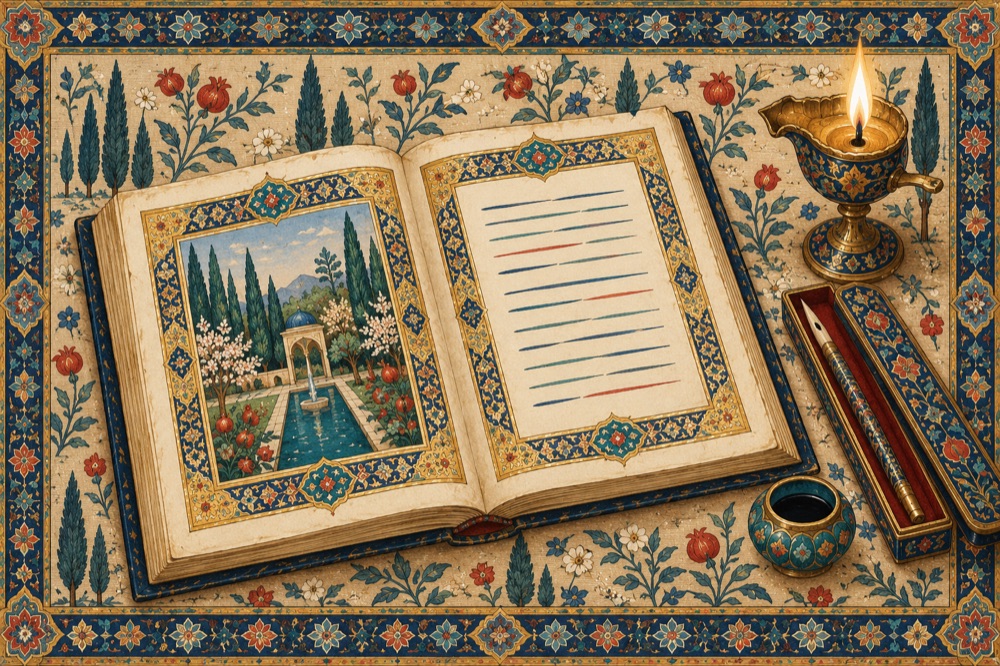
The Khamsa served later poets of the region as a model. Its manuscripts were furnished with miniatures that also depicted Nizami's stories in pictures. These illustrations make the Khamsa both a literary work and a witness to the culture of the handwritten book.
Nizami Ganjavi's work thus offers a rewarding introduction to Persian poetry and to the culture of Azerbaijan. For reading, translations of the epics are recommended, starting with Layla and Majnun, along with further texts on the literature of the region.